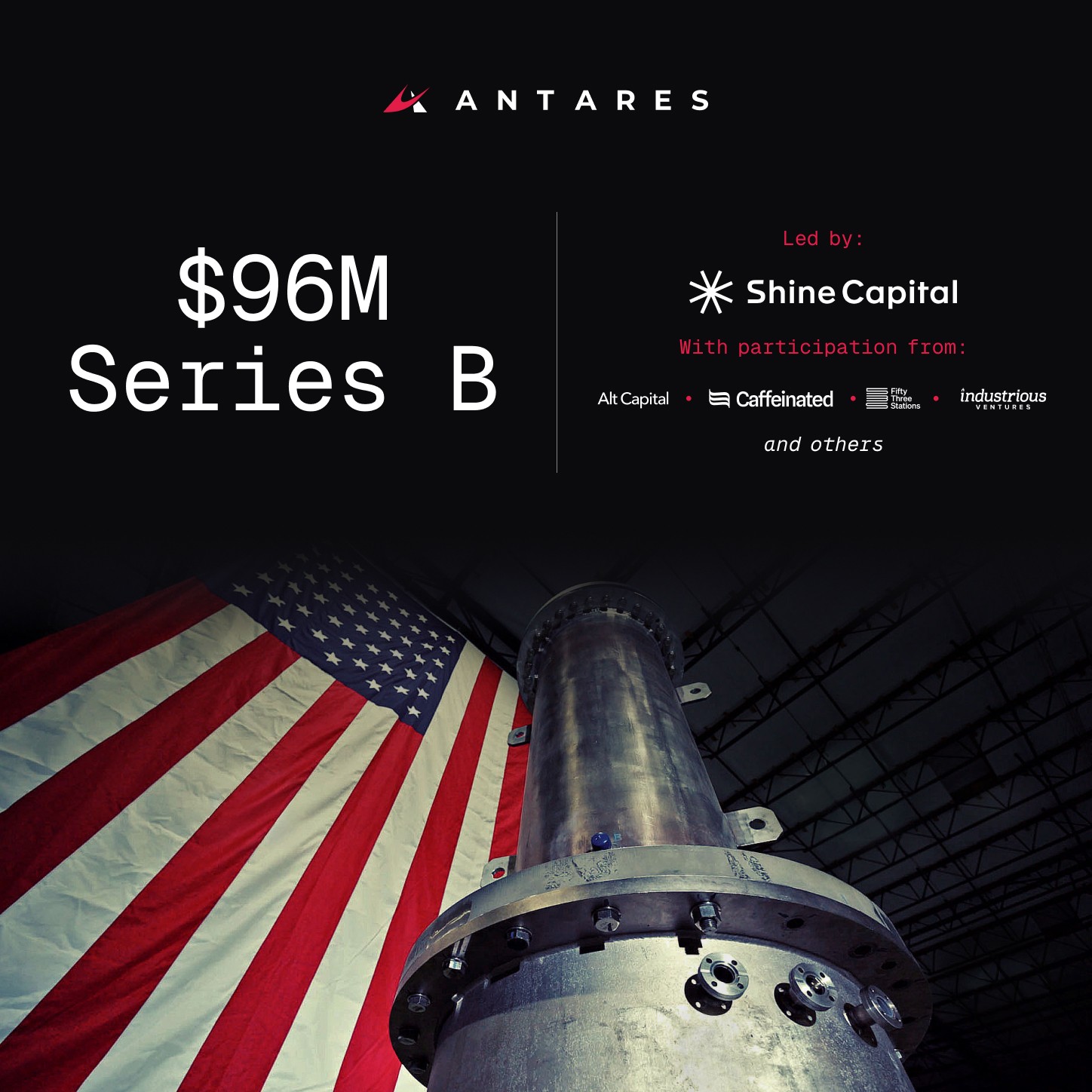
Today, I am excited to announce our $96 million Series B. This capital allows us to move with the speed and discipline required to deliver something America hasn’t done in a very long time: design, build, and test nuclear reactors within a few years—not decades.
I want to share why we raised this capital, what it enables us to do next, and how it fits into the much larger mission we’re pursuing.
When we founded Antares just over two years ago, our early team rallied around a few simple but urgent observations:
Energy scarcity is hindering deployment of America’s most critical national security systems. Simply put, paradigm shifts in warfighting have left the U.S. military lacking electrons where they are most needed.
The U.S. had lost the ability to build nuclear hardware quickly and iteratively. For nearly half a century, nuclear engineering became dominated by paperwork and modeling—designs, analyses, and reviews—without the develop-build-test-iterate cycles required to mature real systems. Entire generations of engineers retired without ever building or operating the hardware they spent their careers designing.
We raised this round to change that trajectory.
This capital will be deployed toward hardware, subsystem testing, fuel fabrication, manufacturing, and the infrastructure required to turn on a reactor and lay the foundation for even more progress to come. We believe that you cannot decouple the design and build phase into a linear process, they must be iterative.
Near-Term: Our First Reactor Demonstration
In 2026, we will conduct a low-power reactor demonstration, the Mark-0 at Idaho National Laboratory. This demo, born out of the opportunity created by Executive Order 14301: Reforming Nuclear Reactor Testing at the Department of Energy will validate the reactor physics and reactivity controls of our R1 design and establish the facility, tooling, and operations required for sustained and enduring testing. Perhaps, most important of all, we will rapidly build institutional expertise with Department of Energy’s DOE-1271 standard for authorization, which will enable us to move faster with more schedule certainty on future test campaigns.
What Comes Next
After we successfully complete Mark-0 operation, we will have a clear pathway to our next major milestone: building a full power, electricity-producing reactor as early as 2027, using the same facility in Idaho. In 2026, we will transition from reactor physics tests to qualifying the full suite of reactor subsystems and constructing our first commercial prototype microreactor—the Mark-1.
This Mark-1 reactor represents the bridge between development and production. It will validate:
Our system performance in expected operating conditions at full power and temperature for at least 90 days.
Our power conversion system and its ability to produce electricity for real-world applications. This closed Brayton cycle system will be the second unit we’ve tested, the first of which will turn on in 2026.
Our safety case for all phases and operating states and the application of passive and inherently safe design characteristics.
Our operations and procedures, including startup, shutdown, and decommissioning.
Our Market is Clear
The capital raised today positions us to compete in several sector-defining federal programs across the Department of the Army, NASA, and other federal agencies.
In October, the Army announced the JANUS program, a microreactor-focused program designed to deliver resilient, secure, and assured energy to support Army bases and operational missions. JANUS represents a substantial investment in the transition from prototypes to commercially viable microreactor solutions for warfighters. We started Antares to provide the Pentagon with reliable power for mission assurance, readiness, and lethality.
Through programs like Project JANUS, the Department has solidified themselves as the first moving customer in advanced nuclear. The first microreactors delivering power to customers in the U.S. will likely be on military installations.
NASA has also announced its Fission Surface Power program, which aims to land a 100-kWe reactor on the lunar surface by 2030. This program’s requirements align with our manufacturing core competencies and design. We believe nuclear power is critical to enabling a space-based industrial economy.
These initiatives demonstrate a clear reality: the United States requires safe, reliable, 24/7 energy across Earth, space, and underwater to assure national security and leadership on the global stage.
Our Long-Term Vision
Over the long term, our goal is simple: abundant energy throughout the Solar System. We’re building the engineering prime of strategic energy, a firm capable of delivering complete fission-powered solutions to the military, NASA, and other federal, commercial, and allied partners. We're focused on enabling high-value mission capabilities, not just a “box of power” that replaces a diesel generator.
With this fundraise, we move one step closer to that vision. We have the facilities, the fuel, and the team to execute one of the fastest and most consequential nuclear development timelines in modern history. The work ahead is hard, but we are clear-eyed and focused on the challenges.
To everyone at Antares: thank you for your determination and hard work. Thank you for the engineering rigor and pride you bring to this effort.
To our partners in government and the commercial sector: we look forward to listening to your needs and building systems that revitalize American industrial capacity and technological leadership.
And to those who want to help build nuclear hardware, come build with us—we’re hiring.
-- Jordan